label

- ancient town
- Biological landscape category
- Water landscape category
- Astronomy and Climate
- Stimulating category
- natural landscape
- Ethnic customs and traditions
- Historical Sites
- Internet celebrity attractions
Price Description
Traffic situation
Scenic spot description
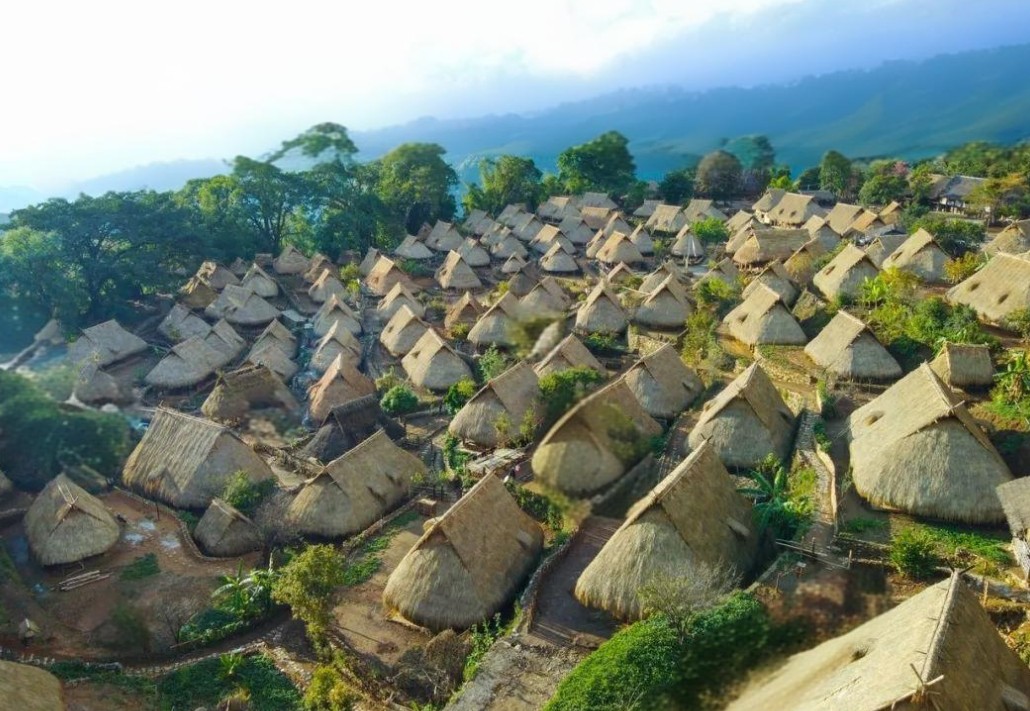
Wengding Village is the most well preserved original ecological village of the Wa ethnic group in China in terms of historical culture and traditional architecture. "Wengding" in Wa language means a place shrouded in clouds and mist, and also has the meaning of the beauty of high mountains, white clouds, and lakes. Wengding Dazhai faces north and south, with the entire village resembling a large chair and surrounded by continuous mountains. The architectural style of the village is unified, consisting of all wooden thatched houses, divided into two types: dry railing style and floor standing style. Residential floor standing houses, dry railing style houses, and attached buildings such as grain storage houses, wooden drum houses, Sala houses, Meiyiji * * houses, and village gates constitute the complete housing system of the Wa ethnic group. Weng Ding Village has a total of 120 cultural relics, including 105 traditional residential buildings and 15 historical environmental elements@On December 17, 2012, Wengding Village was announced as one of the first batch of traditional Chinese villages by the Ministry of Housing and Urban Rural Development, the Ministry of Culture, and the Ministry of Finance@At around 17:40 on February 14, 2021, a serious fire broke out in Laozhai (4A level scenic spot), Wengding Village, Cangyuan Va Autonomous County, Lincang City, Yunnan Province, China, burning 101 houses
Image source: Baidu Baike
Village History
In the early days, the villagers of Weng Ding moved from Shaopa, Shaoxing and other places in the Wa State of Myanmar to Manghui in Cangyuan. With the increasing number of people and insufficient farmland for cultivation, Yang led 9 households to move to present-day Weng Ding Village. In the Wa ethnic customs, the first person to build a village is the village leader, so the position of village leader is inherited by the Yang clan. After more than 400 years of development, Wengding Village has formed an ecological village where the four major surnames of Yang, Xiao, Zhao, and Tian live in contiguous units of clans@Before the liberation, Wengding Village was under the jurisdiction of the Kongjiao Tusi. In 1971, "Wengding" was first used as the place name for this area, which was the Wengding Brigade. After several changes, it was renamed Wengding Village in 1988
Weng Ding Village
Geographical Environment
- Location Realm
- Weng Ding Village (Dazhai) is located in Mengjiao Dai, Yi, and Lahu Ethnic Township, Cangyuan Va Autonomous County, between 99 ° 05 ′ E and 99 ° 18 ′ E longitude and 23 ° 10 ′ N and 23 ° 19 ′ N latitude. It is 33 kilometers away from Cangyuan County, 233 kilometers away from Lincang City, 670 kilometers away from Kunming, and 45 kilometers away from Cangyuan Wa Mountain Airport. The village is located within the scope of the Nangunhe National Nature Reserve Natural Landscape Conservation Area. The area is 6.3 square kilometers
Wengdingwa Village
Nanmang Section, Cangyuan Va Autonomous County, Lincang City, Yunnan Province
Wengdingwa Village
- Terrain and landforms
- Wengdingwa Village is surrounded by dense forests and mountains. To the east lies Wokan Mountain, with an altitude of 2605 meters, which is the highest mountain in Cangyuan Va Autonomous County; To the west lies the Weng Hei Mountain; To the south, there are large mountains known as Gonghan Mountain; There is Gonglao Mountain to the north
- Vegetation
- The forest vegetation in Wengding Village is well protected, and the surrounding forests are dense. The villagers firmly believe in primitive religion, believing that all things have spirits, and have a reverence for mountains, rivers, plants, and trees. They also worship nature and do not casually destroy the surrounding natural scenery. There is a divine forest near the village, with a forest coverage rate of over 90%
- Climate
- Weng Ding Village belongs to subtropical climate with abundant rainfall. The annual average temperature is 24 ℃ and the rainfall is 900-1000 millimeters
Village Features
Site Selection Concept
Weng Ding Village is similar to most Wa villages in that it was built along the mountain, but different from other villages in that it was built along the trees. Before building the village, the ancestors would choose a suitable location to plant a banyan tree. If the banyan tree grows lush, the village will be built here. Otherwise, they can choose another location. The site of Wengding Dazhai is located on a small mountain ridge in the southeast, which is full of mountains and rivers. Looking down, it is in harmony with the landscape pattern, like a fortress in the sky. Weng Ding Village is backed by green mountains and faces the Xinya River to the north. The vegetation is dense, the scenery is beautiful, and the resources are abundant. The village is perfectly integrated with the natural ecological environment, forming a beautiful mountain ecological landscape of harmony between people and land. The good natural ecological environment has become the environmental foundation for Weng Ding Wa people to believe in primitive religion. The villagers worship nature and have a reverence for mountains, rivers, plants, and trees. Longtan is located on the southwest side of the village, with an area of about 300 square meters, and has practical significance for water storage and fire prevention
Spatial Layout
The architectural layout of Wengding Village is built along the mountain, with the entrance of the building staircase facing the center of the village. The most important feature of residential distribution is the formation of a terrace pattern based on the terrain and landforms. Dazhai faces north and south, with the entire village resembling a large chair and surrounded by continuous mountains. There is a village center distributed within the village, which is a place for holding * * activities and festivals; Bull head stakes are mostly concentrated on both sides of the village entrance road and folk squares in front of the village gate; The goddess totem pole is erected on the southwest side of the folk square
The main roads in Wengding Village are in the shape of eight trigrams, and the overall road layout presents a natural texture from the main road to the alleys, resembling leaf veins; Middle aged banyan trees can be seen everywhere in Wengding Village, and the village is surrounded by them. The oldest ancient banyan tree has a history of more than 400 years. Villagers regard this tree as a sacred tree and worship it to express their nostalgia and reverence for their ancestors; The divine forest in the southeast of the village is located on a hillside, and only men in the village can enter. The houses are hidden in the dense forest, and there are houses built in them, which can be reached by mountain paths. Its sacredness also allows this forest to be well preserved; Longtan, located in the southwest corner of the village, was artificially excavated a hundred years ago to pray for disaster relief. Today, it connects residential banyan trees and terraced fields, becoming a richly layered natural landscape; On the south side of the village, a clear spring from a water channel flows into the pond, and the scattered water mill houses around it reflect a harmonious scene of coexistence between humans and nature in the preservation of historical life; There are also tea gardens and terraced fields cultivated by villagers around the village. The village, sacred forest, banyan tree, agricultural fields, and Xinya River form a three-dimensional rural settlement environment landscape characterized by mountains
Weng Ding Village
Architectural Features
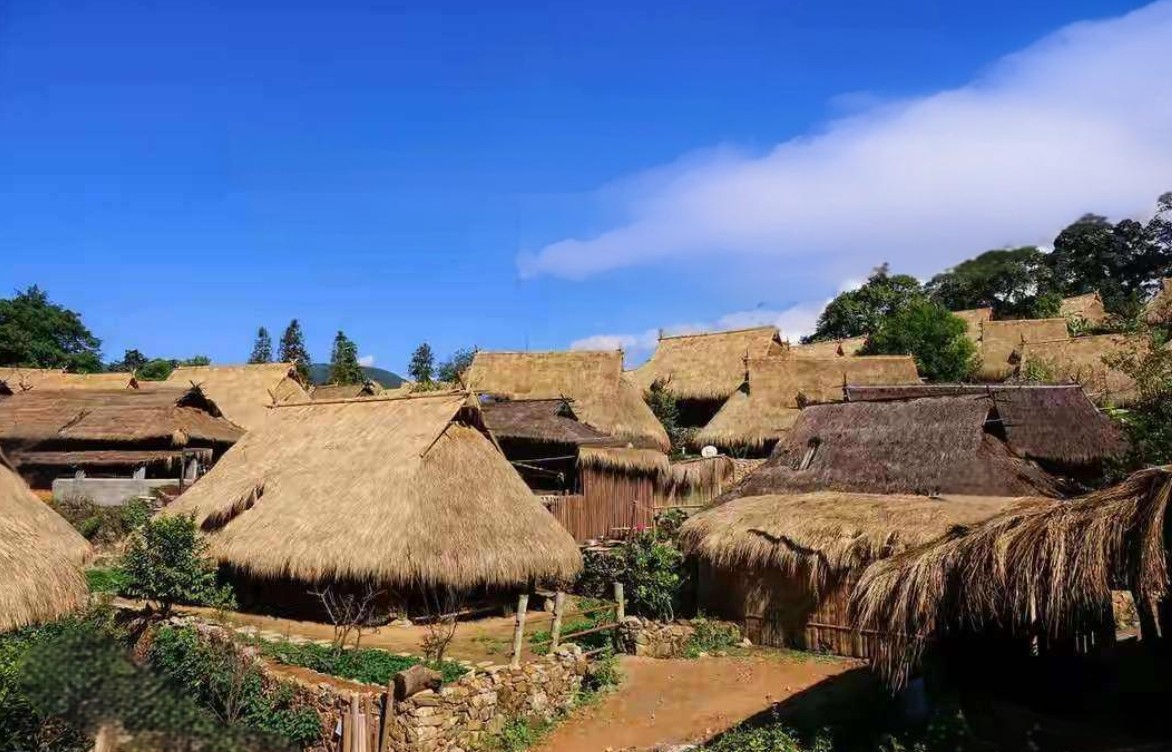
Weng Ding Village has a unified architectural style, consisting of all wooden thatched houses, divided into two types: dry railing and floor standing. Residential floor standing houses, dry railing houses, and attached buildings such as grain storage houses, wooden drum houses, Sala houses, Meiyiji * * houses, and village gates constitute the complete housing and architectural system of the Wa ethnic group, with strong ethnic characteristics
The traditional dry railing style buildings of the Wa ethnic group are mainly made of grass, bamboo, and wood as the main building materials. They are locally sourced, structurally simple, easy to construct, and cost-effective. The houses have good ventilation and heat dissipation, warm in winter and cool in summer, and good drainage performance, making them suitable for hot and rainy areas. The biggest difference between the Wa ethnic group's ganlan style architecture and other ethnic groups' ganlan style architecture lies in the forked roofs on both sides, so the Wa ethnic group's ganlan style residential buildings are also called "forked houses". The building is built with wooden columns, bamboo or wooden boards woven into bundles as walls, and thatched roofs. The roof is mostly equipped with forked wind boards, and stairs are made of whole wood. The top of the wooden pillar retains tree branches to support the beam, and then some fine bamboo is placed on the crossbeam, covered with thatch, to build an elevated "bamboo tower". The house is divided into two floors, with people living on the upper floor and livestock and poultry activities on the lower floor. Some blacksmith households also have bellows and a set of blacksmith tools on the lower floor
Recommend Trip
Guess you like it
Recommended tourist attractions
Guess you like it